The Shoes I Never Wanted
When I was a child, I practiced track and field and was very particular about the shoes I wore for running.
For me, running shoes were not just something I put on my feet. I knew they needed to be appropriate for running, so I paid attention to the kind of shoes I chose.
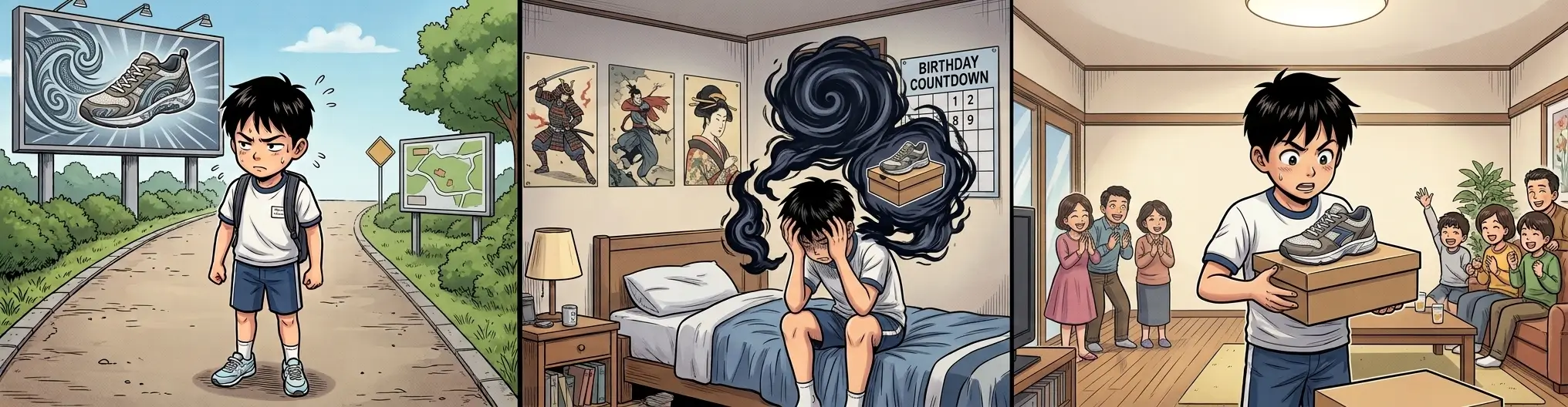
Then, shortly before my birthday, a shoe company released a new model. The advertisement said that it was suitable for any occasion, including running.
The first time I saw the advertisement, I had a strange and very strong feeling.
"I never want to have those shoes. I don't like them at all."
At that moment, I simply did not want those shoes.
I didn't like them.
🎁 My Birthday Was Coming
Since my birthday was approaching, my parents told me they were going to have a small celebration at home.
And then those shoes began to occupy more and more space in my mind.
I started thinking:
"What if they give me those shoes?"
I didn't want them.
But precisely because I didn't want them, I began imagining the possibility of receiving them.
I thought about those shoes.
I imagined opening a birthday present and finding them inside.
And that initial feeling of rejection gradually became something else as well: a kind of fear.
The more I thought about the possibility, the more real it seemed inside me.
🎁 The Gift
Finally, my birthday arrived.
The celebration was taking place at home, and at some point I received a package that looked exactly like a shoebox.
Before I even opened it, I had that same feeling again.
It was almost a certainty.
I knew, somehow, that the shoes I didn't want were inside.
I opened the package.
And there they were.
Exactly the same model I had seen in the advertisement.
The very shoes I had felt, from the beginning, that I never wanted.
🤔 What Was Happening Inside Me?
For a long time, this story could simply have been dismissed as a coincidence.
But many years later, when I began studying the relationship between thought, imagination, emotion, and experience, I started looking at it differently.
I don't believe the explanation is simply, "I thought about the shoes, and they appeared."
After all, we have thousands of thoughts throughout the day, and not everything we think about happens.
What stands out to me about this story is something else.
I had a very clear idea: I did not want those shoes.
That idea captured my attention.
My imagination began working around it.
And my imagination awakened an emotion.
At first, it was rejection.
Then, as my birthday approached, that rejection gradually turned into concern and fear.
Without realizing it, I was giving more and more attention to exactly what I did not want.
⚡ Attention Matters Too
This experience taught me something I consider very important: we need to pay attention not only to what we want.
We also need to notice what we are feeding with our attention.
When we say, "I don't want this," we may believe we are pushing something away.
But if we continue thinking about it, imagining it, and experiencing emotions connected to it, we are still keeping that possibility alive within our experience.
Attention works like a focus.
Whatever we repeatedly return to in our minds begins to gain importance within us.
And when imagination joins with emotion, something that was initially only a possibility can begin to feel increasingly real.
This does not mean that every isolated thought determines what will happen.
The important thing is to notice what we are repeatedly imagining, where we are placing our attention, and what feeling we are feeding.
🌉 Feeling Is the Bridge
When I look back at this story today, I see a very simple sequence.
First, there is an idea.
That idea can be something we desire or something we fear.
Imagination then gives form to the idea.
And the image created by imagination awakens an emotion or feeling.
That is exactly what happened to me.
I didn't want those shoes.
But the idea of those shoes entered my mind.
My imagination began working with that possibility.
And the feeling made that possibility increasingly alive within me.
It is interesting to compare this experience with another story from my childhood: the Brandani bicycle I wanted so much.
In that story, the movement was:
I want this.
Idea → imagination → feeling → experience.
In this story, the movement was:
I don't want this.
Idea → imagination → rejection/fear → experience.
Both stories happened during my childhood, long before I knew anything about consciousness, imagination, or the role of feeling.
And perhaps that is precisely what makes them so interesting.
I wasn't trying to apply any technique.
I was simply living.
💭 A Question for All of Us
Perhaps the most important question is not: "Am I thinking positively?"
Perhaps it is: "What am I imagining and feeling as though it were already happening?"
What do I really want?
Where am I placing my attention?
What am I repeatedly imagining?
And what feeling is that imagination awakening in me?
These questions can help us become aware of something that normally happens automatically.
Because many times, we are not simply thinking.
We are imagining.
And we are not simply imagining.
We are feeling.
And that is where things begin to become interesting.
Feeling Is the Bridge"First there is an idea. Imagination gives form to that idea. Feeling gives life to imagination. And what comes alive within us can begin to influence the way we perceive and experience reality."
— Edmar Sasaki